75% of AI Economic Gains Go to 20% of Companies — PwC 2026 AI Performance Study
PricewaterhouseCoopers has released its 2026 AI Performance Study, finding that 75% of measurable economic gains from artificial intelligence are accruing to just 20% of companies — predominantly large enterprises with existing data infrastructure advantages, creating a “winner-take-most” dynamic that is widening the gap between AI leaders and laggards.
Key Findings
- Companies in the top AI adoption quartile are 4.3x more productive than bottom quartile peers
- The productivity gap between AI leaders and laggards doubled between 2024 and 2026
- 75% of AI economic value is captured by companies with 10,000+ employees
- Small businesses adopting AI see average 23% productivity gains — but adoption rate is only 18%
- AI leaders spend 3.2x more on data infrastructure than AI laggards
Industries Leading in AI Adoption
- Financial Services: Fraud detection, trading, risk modeling — 67% advanced adoption
- Technology: Code generation, product development — 71% advanced adoption
- Healthcare: Diagnostics, drug discovery — 45% advanced adoption
- Manufacturing: Predictive maintenance, quality control — 42% advanced adoption
- Retail: Demand forecasting, personalization — 38% advanced adoption
Why Large Companies Win
The AI advantage compounds with data:
- Larger training datasets produce better custom models
- More resources to hire AI engineers and data scientists
- Existing cloud infrastructure reduces deployment costs
- Regulatory compliance frameworks already in place
- Can afford to experiment and absorb failed AI projects
What Smaller Organizations Can Do
# Use foundation models via API instead of training custom models
# OpenAI, Anthropic, Google — per-token pricing levels the playing field

# Open-source models for cost-sensitive workloads
# Llama 4, Mistral, Qwen — competitive with commercial models
ollama pull llama4-scout:17b
ollama run llama4-scout:17b

# Focus AI on highest-ROI use cases first
# 1. Code generation (saves developer hours immediately)
# 2. Customer support automation
# 3. Document analysis and summarization
# 4. Fraud/anomaly detection

# Tools that democratize AI for smaller teams
# n8n.io — open-source AI workflow automation
# Flowise — open-source LangChain UI
# LangChain — framework for LLM-powered applications
pip install langchain
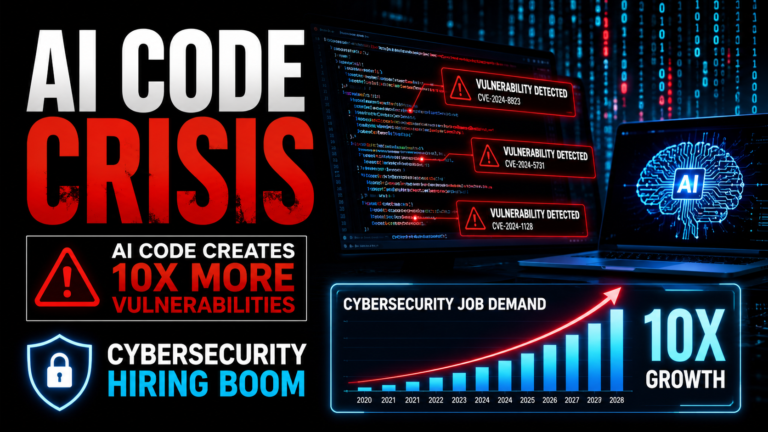
AI in Cybersecurity — The Security Gap
The study notes a concerning finding for smaller organizations: large enterprises are deploying AI-powered security tools that catch attacks that would succeed against smaller targets using traditional tools.
- AI-powered SIEM reduces mean time to detect (MTTD) from 197 days to 12 days
- Only 22% of SMBs use AI-powered security tools vs 71% of large enterprises
- Attackers are also adopting AI — generating more sophisticated phishing, evasive malware
The SudoFlare Takeaway
The AI divide is real and widening. For individual developers and security professionals, the most important response is personal: develop AI skills aggressively. The value of being in the top 20% of AI-capable practitioners is compounding rapidly. Open-source models make powerful AI accessible to anyone — the barrier is knowledge, not cost.