C++ RAII & Resource Management: The Pattern That Defines C++ 2026
Table of Contents
What Is RAII
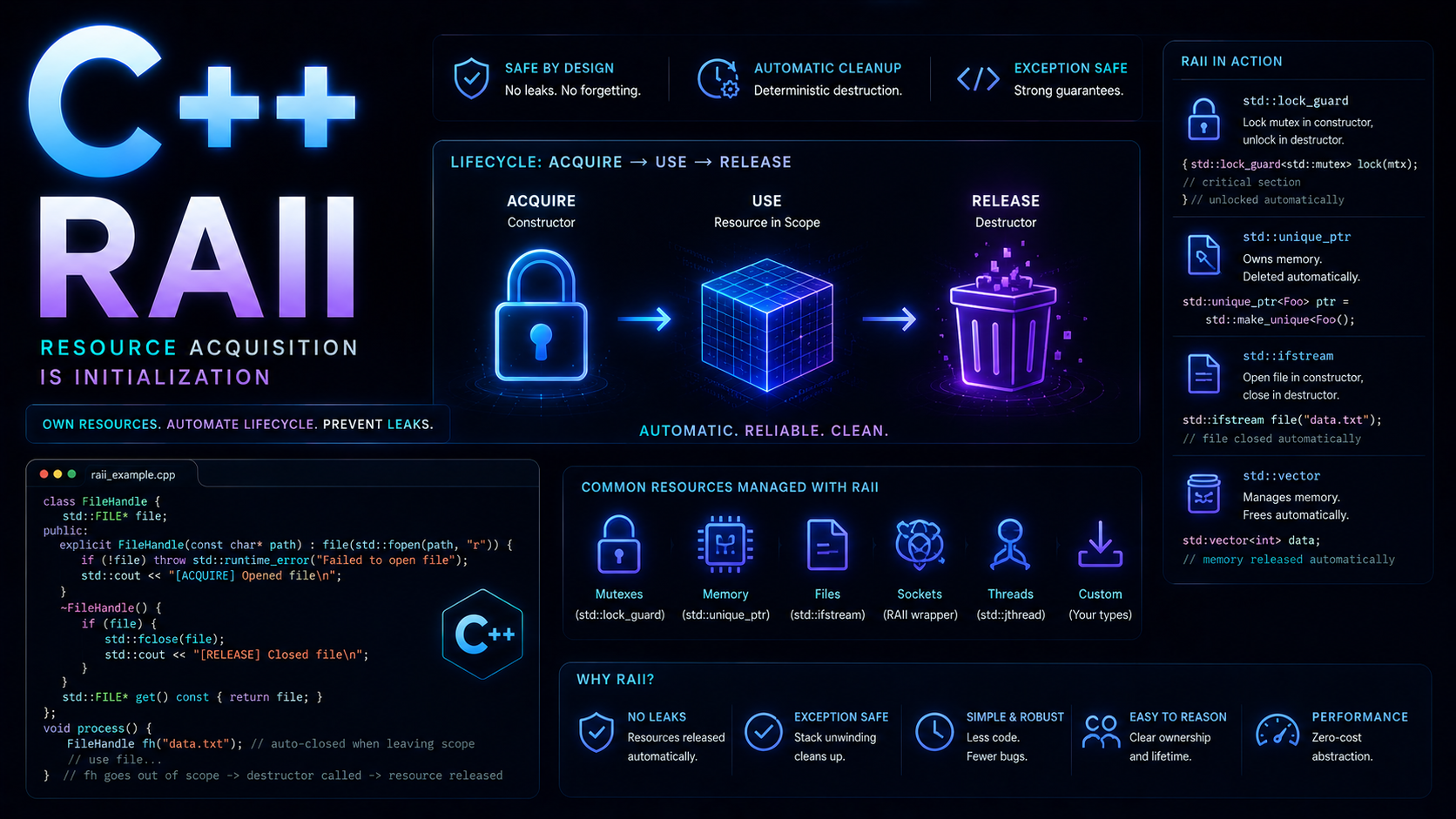
RAII stands for Resource Acquisition Is Initialization — a terrible name for C++’s most important pattern. The idea is simple: tie every resource (memory, file handle, network socket, mutex lock, database connection) to an object’s lifetime. The constructor acquires the resource. The destructor releases it. When the object goes out of scope, cleanup happens automatically — no matter how the scope exits, including via exceptions.
RAII is what makes C++ unique among systems languages. It gives you deterministic cleanup without a garbage collector. You always know exactly when resources are released. If you’ve used smart pointers, fstream, or lock_guard, you’ve already used RAII — this lesson shows you the underlying pattern and how to build your own RAII types.
The Problem RAII Solves
// WITHOUT RAII: manual resource management
void risky_function() {
    int* data = new int[1000];
    FILE* file = fopen("data.txt", "r");
    mutex.lock();

    // ... do work ...

    if (error_condition) {
        // LEAK: forgot to clean up before returning!
        return;
    }

    // ... more work that might throw an exception ...
    process(data);  // If this throws, everything below is skipped

    delete[] data;    // Only reached if nothing went wrong
    fclose(file);
    mutex.unlock();
}

// WITH RAII: automatic cleanup guaranteed
void safe_function() {
    auto data = std::make_unique<int[]>(1000);  // auto-deleted
    std::ifstream file("data.txt");                // auto-closed
    std::lock_guard lock(mutex);                   // auto-unlocked

    if (error_condition) return;  // All cleanup happens automatically!

    process(data.get());  // If this throws, cleanup still happens!
}
// Destructors run here — in reverse order of construction
RAII in Practice
#include <iostream>
#include <string>

class TraceScope {
    std::string name_;
public:
    TraceScope(const std::string& name) : name_(name) {
        std::cout << "Entering " << name_ << "
";
    }
    ~TraceScope() {
        std::cout << "Leaving " << name_ << "
";
    }
};

void example() {
    TraceScope scope("example");     // "Entering example"

    {
        TraceScope inner("block");   // "Entering block"
        if (true) return;            // "Leaving block" then "Leaving example"
    }                                // "Leaving block" (if no early return)
}                                    // "Leaving example"
// Destructors ALWAYS run, even on return or exception
Standard Library RAII Types
#include <memory>
#include <fstream>
#include <mutex>
#include <vector>
#include <string>

void stdlib_raii_examples() {
    // Smart pointers — RAII for heap memory
    auto ptr = std::make_unique<int>(42);      // auto delete
    auto shared = std::make_shared<std::string>("hello"); // ref-counted

    // Containers — RAII for dynamic arrays
    std::vector<int> vec = {1, 2, 3};          // auto-freed
    std::string str = "hello";                  // auto-freed

    // File streams — RAII for file handles
    std::ifstream file("data.txt");             // auto-closed

    // Locks — RAII for mutex ownership
    std::mutex mtx;
    std::lock_guard lock(mtx);                  // auto-unlocked
    std::unique_lock ulock(mtx);                // auto-unlocked

    // All cleanup happens when these go out of scope
}
// Everything released here — no leaks possible
Writing Your Own RAII Classes
#include <iostream>
#include <stdexcept>

// RAII wrapper for a C-style resource (e.g., C library handle)
class DatabaseConnection {
    int handle_;  // Simulated C handle

    static int connect(const char* url) {
        std::cout << "Connecting to " << url << "
";
        return 42;  // Simulated handle
    }

    static void disconnect(int handle) {
        std::cout << "Disconnecting handle " << handle << "
";
    }

public:
    // Constructor acquires the resource
    explicit DatabaseConnection(const char* url)
        : handle_(connect(url))
    {
        if (handle_ < 0) {
            throw std::runtime_error("Connection failed");
        }
    }

    // Destructor releases the resource
    ~DatabaseConnection() {
        if (handle_ >= 0) {
            disconnect(handle_);
        }
    }

    // Delete copy (resource is unique)
    DatabaseConnection(const DatabaseConnection&) = delete;
    DatabaseConnection& operator=(const DatabaseConnection&) = delete;

    // Allow move (transfer ownership)
    DatabaseConnection(DatabaseConnection&& other) noexcept
        : handle_(other.handle_) {
        other.handle_ = -1;  // Source no longer owns it
    }

    DatabaseConnection& operator=(DatabaseConnection&& other) noexcept {
        if (this != &other) {
            if (handle_ >= 0) disconnect(handle_);
            handle_ = other.handle_;
            other.handle_ = -1;
        }
        return *this;
    }

    void query(const char* sql) {
        std::cout << "Query on handle " << handle_ << ": " << sql << "
";
    }
};

void use_database() {
    DatabaseConnection db("postgres://localhost/mydb");
    db.query("SELECT * FROM users");
    // db automatically disconnected here
}
RAII for Files
#include <cstdio>
#include <stdexcept>

// Wrap C FILE* in RAII
class CFile {
    FILE* fp_;
public:
    CFile(const char* path, const char* mode) : fp_(fopen(path, mode)) {
        if (!fp_) throw std::runtime_error("Cannot open file");
    }

    ~CFile() {
        if (fp_) fclose(fp_);
    }

    CFile(const CFile&) = delete;
    CFile& operator=(const CFile&) = delete;

    CFile(CFile&& other) noexcept : fp_(other.fp_) { other.fp_ = nullptr; }

    FILE* get() { return fp_; }

    void write(const char* data) {
        fprintf(fp_, "%s", data);
    }
};

void safe_file_write() {
    CFile f("log.txt", "a");
    f.write("Entry 1
");
    f.write("Entry 2
");
    // File closed automatically, even if write throws
}
RAII for Locks
#include <mutex>
#include <iostream>

// How lock_guard works internally (simplified)
template<typename Mutex>
class SimpleLockGuard {
    Mutex& mtx_;
public:
    explicit SimpleLockGuard(Mutex& m) : mtx_(m) {
        mtx_.lock();       // Acquire on construction
    }
    ~SimpleLockGuard() {
        mtx_.unlock();     // Release on destruction
    }

    SimpleLockGuard(const SimpleLockGuard&) = delete;
    SimpleLockGuard& operator=(const SimpleLockGuard&) = delete;
};

std::mutex mtx;
int shared_data = 0;

void safe_increment() {
    SimpleLockGuard lock(mtx);  // Lock acquired
    ++shared_data;
    // If an exception is thrown here, the lock is still released
}  // Lock released automatically
RAII for Network Connections
#include <iostream>
#include <string>
#include <memory>

// RAII socket wrapper pattern
class TcpSocket {
    int fd_ = -1;

public:
    TcpSocket(const std::string& host, int port) {
        // fd_ = ::socket(AF_INET, SOCK_STREAM, 0);
        // ::connect(fd_, ...);
        fd_ = 3;  // Simulated
        std::cout << "Connected to " << host << ":" << port << "
";
    }

    ~TcpSocket() {
        if (fd_ >= 0) {
            // ::close(fd_);
            std::cout << "Socket closed
";
        }
    }

    TcpSocket(TcpSocket&& other) noexcept : fd_(other.fd_) {
        other.fd_ = -1;
    }

    TcpSocket(const TcpSocket&) = delete;
    TcpSocket& operator=(const TcpSocket&) = delete;

    void send(const std::string& data) {
        std::cout << "Sending: " << data << "
";
    }
};

// Usage: connection always cleaned up
void fetch_data() {
    TcpSocket sock("api.example.com", 443);
    sock.send("GET / HTTP/1.1
");
    // Socket auto-closed when sock goes out of scope
}
Rule of Zero
If your class only uses RAII types (smart pointers, strings, vectors, etc.) as members, you don’t need to write any special member functions. The compiler-generated defaults handle everything correctly. This is the Rule of Zero — the preferred approach in modern C++.
// Rule of Zero: no custom destructor, copy, or move needed
class UserProfile {
    std::string name_;
    std::string email_;
    std::vector<std::string> roles_;
    std::shared_ptr<Database> db_;

public:
    UserProfile(std::string name, std::string email, std::shared_ptr<Database> db)
        : name_(std::move(name))
        , email_(std::move(email))
        , db_(std::move(db))
    {}

    // No destructor needed — all members clean themselves up
    // No copy constructor needed — compiler generates correct one
    // No move constructor needed — compiler generates correct one
    // No assignment operators needed — compiler generates them
};
Rule of Five
If you manage a raw resource directly (raw pointer, file descriptor, C handle), you must define all five special member functions: destructor, copy constructor, copy assignment, move constructor, move assignment. If you define any one of them, define all five.
class Buffer {
    int* data_;
    size_t size_;

public:
    // Constructor
    explicit Buffer(size_t size) : data_(new int[size]), size_(size) {}

    // 1. Destructor
    ~Buffer() { delete[] data_; }

    // 2. Copy constructor
    Buffer(const Buffer& other) : data_(new int[other.size_]), size_(other.size_) {
        std::copy(other.data_, other.data_ + size_, data_);
    }

    // 3. Copy assignment
    Buffer& operator=(const Buffer& other) {
        if (this != &other) {
            delete[] data_;
            size_ = other.size_;
            data_ = new int[size_];
            std::copy(other.data_, other.data_ + size_, data_);
        }
        return *this;
    }

    // 4. Move constructor
    Buffer(Buffer&& other) noexcept : data_(other.data_), size_(other.size_) {
        other.data_ = nullptr;
        other.size_ = 0;
    }

    // 5. Move assignment
    Buffer& operator=(Buffer&& other) noexcept {
        if (this != &other) {
            delete[] data_;
            data_ = other.data_;
            size_ = other.size_;
            other.data_ = nullptr;
            other.size_ = 0;
        }
        return *this;
    }
};

// Better: use unique_ptr and follow Rule of Zero
class ModernBuffer {
    std::unique_ptr<int[]> data_;
    size_t size_;

public:
    explicit ModernBuffer(size_t size)
        : data_(std::make_unique<int[]>(size)), size_(size) {}
    // Rule of Zero — no special functions needed!
};
Scope Guards
#include <functional>
#include <iostream>

// Scope guard: run arbitrary cleanup on scope exit
class ScopeGuard {
    std::function<void()> cleanup_;
    bool active_ = true;

public:
    explicit ScopeGuard(std::function<void()> f) : cleanup_(std::move(f)) {}

    ~ScopeGuard() {
        if (active_) cleanup_();
    }

    void dismiss() { active_ = false; }  // Cancel cleanup

    ScopeGuard(const ScopeGuard&) = delete;
    ScopeGuard& operator=(const ScopeGuard&) = delete;
};

void transactional_operation() {
    start_transaction();

    // If we don't commit, rollback on scope exit
    ScopeGuard rollback([]() {
        std::cout << "Rolling back
";
        rollback_transaction();
    });

    step1();  // Might throw
    step2();  // Might throw
    step3();  // Might throw

    commit_transaction();
    rollback.dismiss();  // Success — don't rollback
}
RAII vs Garbage Collection
Languages like Java, Python, and Go use garbage collectors to manage memory. GC is convenient but has trade-offs: cleanup timing is unpredictable, finalization order is unspecified, and non-memory resources (files, sockets, locks) need manual handling with try/finally or using/with blocks.
RAII gives you deterministic destruction — you know exactly when resources are released (at the closing brace). This matters for resources where timing is critical: database connections should be returned to the pool promptly, locks should be held briefly, files should be flushed and closed before you read them from another process. C++ is the only major language where this pattern works reliably for all resource types, not just memory.
Common Mistakes
// MISTAKE 1: Raw owning pointers in classes
class Bad {
    int* data_;  // Who deletes this? When?
};

// MISTAKE 2: Catching exception and forgetting re-throw
void bad_error_handling() {
    auto ptr = std::make_unique<int>(42);
    try {
        risky_operation();
    } catch (...) {
        // ptr is still alive here — RAII works with exceptions!
        // Don't manually delete RAII objects in catch blocks
        throw;  // Re-throw to propagate
    }
}

// MISTAKE 3: Storing raw pointers from RAII objects
int* get_data() {
    auto vec = std::make_unique<std::vector<int>>();
    vec->push_back(42);
    return vec->data();  // DANGLING: vec destroyed, pointer invalid
}

// MISTAKE 4: Using RAII object after move
void moved_from() {
    auto ptr = std::make_unique<int>(42);
    auto ptr2 = std::move(ptr);
    // *ptr;  // UNDEFINED: ptr is in moved-from state
}
Practice Exercises
Exercise 1: Write an RAII wrapper for a timer that prints elapsed time when the scope exits. Use std::chrono to measure the duration.
Exercise 2: Create an RAII class that wraps a temporary file — the constructor creates the file, and the destructor deletes it. Support move but not copy.
Exercise 3: Implement a connection pool where connections are RAII objects. When a connection object is destroyed, it returns itself to the pool instead of closing.
Exercise 4: Refactor a class that violates the Rule of Five (has raw pointers) to follow the Rule of Zero using std::unique_ptr and std::vector.
RAII is the pattern that makes C++ what it is. It’s why C++ can be both a systems language (no GC overhead, deterministic cleanup) and a high-level language (no manual resource management). Every lesson in this course has used RAII: smart pointers, file streams, lock guards, containers. Understanding the pattern explicitly ties everything together. Next: modern C++ best practices.